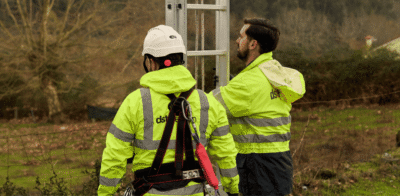
The reuse of materials is playing an increasingly important role in promoting sustainable practices. Against this backdrop, dstelecom, in partnership with the Polytechnic Institute of Viana do Castelo (IPVC), challenged students to develop innovative products from scrap fiber optic cables.
The initiative is now being highlighted as part of World Recycling Day, celebrated on 17 May.
“The work carried out by the students at IPVC shows that sustainability can also stem from the ability to look at materials in a different way. At dstelecom, we want to encourage this perspective: transforming surplus materials from our operations into solutions that are useful, creative and purposeful,” says Ricardo Salgado, CEO of dstelecom.
The projects were developed as part of the Master’s in Integrated Design at the IPVC School of Technology and Management, under the supervision of Cláudio Bastos from dstelecom.
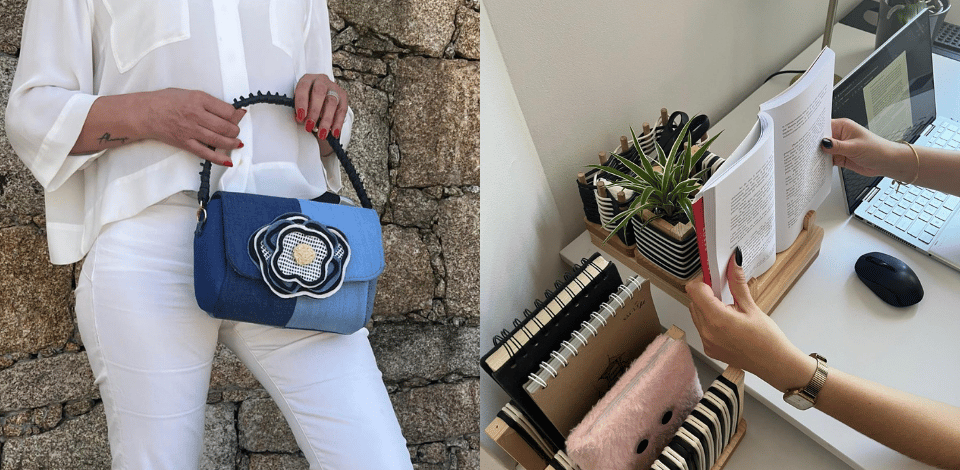
Andreia Batista developed one of the projects, inspired by the Dior Cruise 2020 collection and the need to revitalise the traditional embroidery of Crivo de São Miguel da Carreira, classified as Portuguese Intangible Cultural Heritage. With the help of artisan Maria Elisabete, she created a blazer, a bag and other accessories, such as a belt. The pieces combine linen and denim, incorporating optical fibre cables as a structural and decorative element, notably in the construction of the jacket’s flower, whose petals reinterpret the characteristic checkered pattern of crivo embroidery.
The finished pieces are a representation of history and transformation or, as Andreia puts it, “I see this work as a bridge between tradition and innovation, showing that traditional craft techniques can be reinvented in a contemporary way. In the future, I would like it to be shown to more people and explored commercially, highlighting the authenticity and unique character of each piece.”
João Fonseca, meanwhile, drew inspiration from growing concerns about mental health and his direct observation of rising stress and anxiety in the workplace. With this as his starting point, he developed a modular office organisation system, using fibre-optic cables to create supports, baskets, storage areas and plant modules, which allow the user to build a more organised, personalised space that feels closer to nature. This modular system utilises the interlacing of the fibre optic cable, combining it with wood to create structural meshes with a practical function and their own visual identity.
“This project represents a starting point for exploring the relationship between design, well-being and sustainability. Today, it is seen as a solid foundation, but one that is still evolving. In the future, the aim is to test and develop this proposal in real-world contexts. The goal is to transform it into a relevant and accessible solution. More than just a product, the aim is to generate a positive impact on the workplace,” revealed the student.
Source: e-Cultura