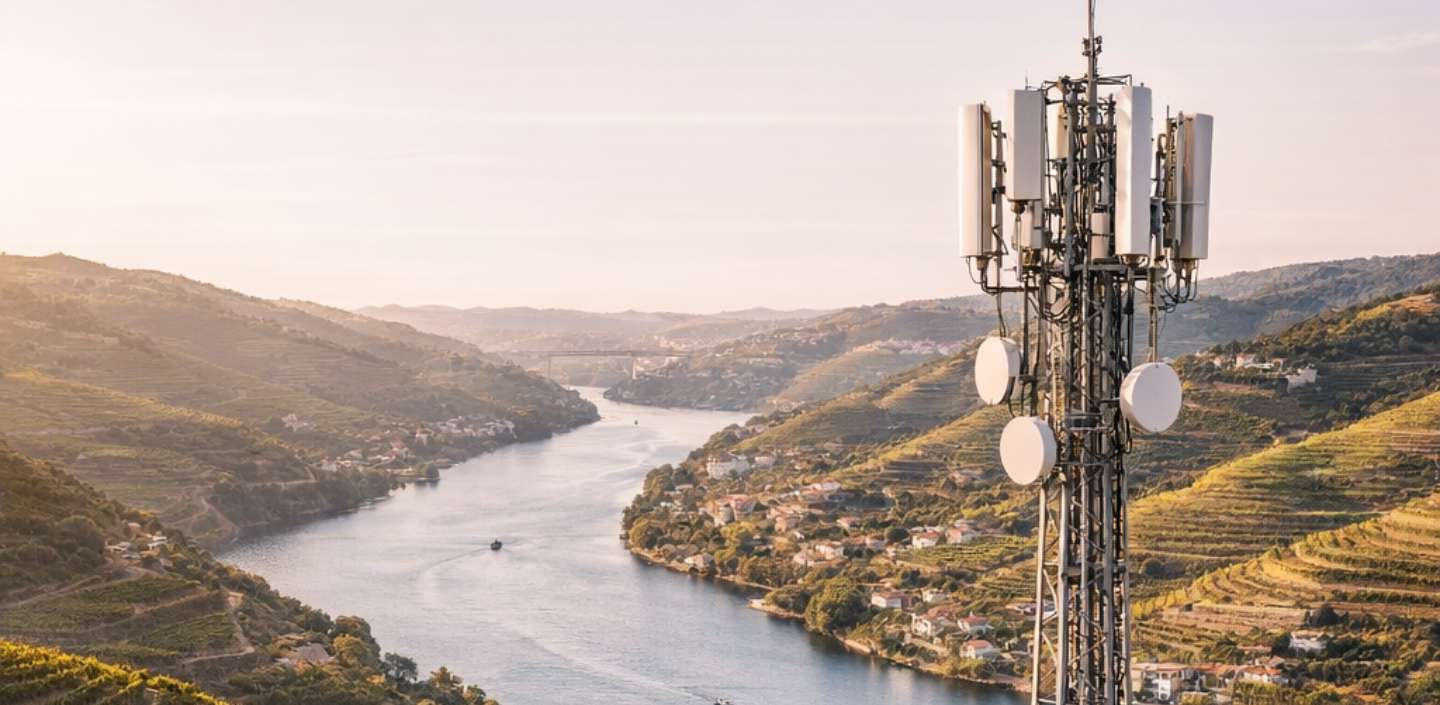
The 5G.CONNECT project aims to improve network coverage in remote areas and boost digital and tourism services.
The 5G mobile network will be installed in 45 municipalities in the Northern region and along the Douro River as part of a project aimed at improving network coverage in more remote areas by “25 to 50%,” dstelecom revealed on Thursday.
The project, which will be presented on Friday in Carrazeda de Ansiães, will involve municipalities from four Intermunicipal Communities (CIMs): CIM Douro, CIM do Alto Tâmega e Barroso, CIM do Tâmega e Sousa, and CIM das Terras de Trás-os-Montes.
Speaking to Lusa, Ricardo Henriques, manager of the 5G.Connect, project led by dstelecom, explained that the goal is to bring “digital connectivity to regions with low population density” through the installation of 25 antennas that will cover a radius of three to four kilometers.
“The district capitals already have very good 5G coverage, and the goal is precisely to bring the 5G network to those populations that are more isolated and more dispersed,” he emphasized.
According to Ricardo Henriques, 5G network coverage in these regions is “more complex” due to the terrain, but also because the population is very scattered; therefore, these new antennas will cover “between 25 and 50 percent” of the dead zones.
The project also includes digital services—funded by municipalities—in the areas of climate action, civil protection, heritage, and social services, which will bring “socioeconomic benefits to the communities.”
“For example, sustainable mobility, fire detection, social services—such as remote monitoring of the elderly through teleconsultations—and we also have a ‘digital twin’ initiative that allows us to digitize buildings, as well as in the energy sector, with the creation of renewable energy communities,” he listed.
In addition to covering the 45 municipalities, the goal is also to provide 5G coverage to those traveling on the Douro River.
“We’ve already had a similar project in the south, and this time, we’ve designed the project here to focus somewhat on the Douro River as well (…) The Douro River waterway is attracting more and more tourists—it already has over one million tourists per year,” the official emphasized.
The 5G.Connect project will cost 10 million euros, 75% of which will be funded by the European Union, with the remainder coming from the companies involved in the consortium—dstelecom, NOS, innovationPoint/MOSAIC, dstgroup, and IrRADIAR—as well as the Douro Intermunicipal Community, as a partner.
Work has already begun, with meetings held with the municipalities, and it is expected that installation of the antennas—provided by the operator NOS—will start early next year, with the project completed and the 5G network available by the end of 2028.
Source: Sic Notícias